Table of Contents
Introduction
Detailed General Science Theory
Physics
Chemistry
Biology
Exam Weightage and Trend
Shortcuts and Tricks
Summary Notes
25 Practice MCQs with Answers
FAQs
SEO Meta Data
Internal Linking Suggestions
Image Prompt + Alt Text
RRB NTPC General Science Notes PDF 2025 | Physics, Chemistry, Biology
Introduction
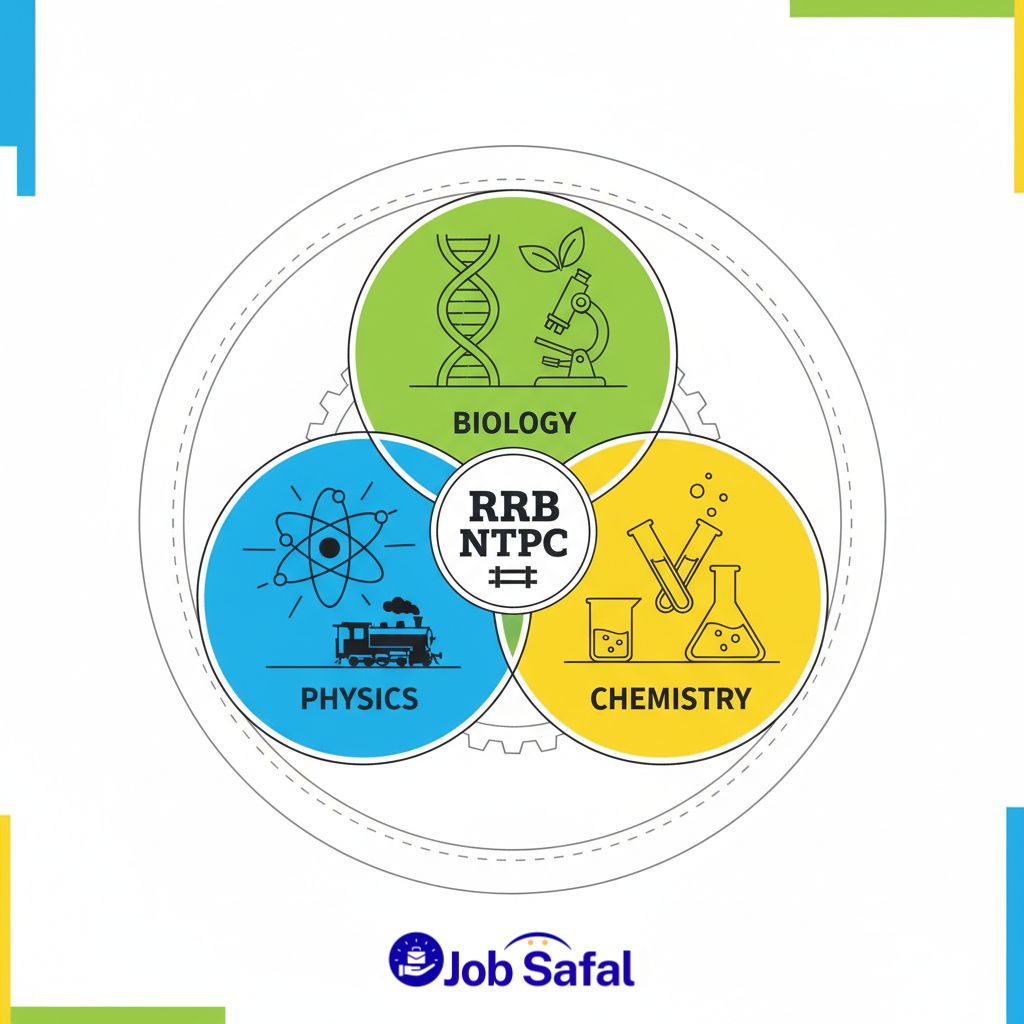
General Science plays a vital role in the RRB NTPC exam because it checks how well a student understands the world around them. Questions come from Physics, Chemistry, and Biology, and they are simple but concept based. A strong foundation in science helps students score higher in the General Awareness section and boosts overall performance.
This guide provides fully original, exam focused, easy to revise science notes for RRB NTPC. These notes follow a simple style so that learners at all levels can understand and move forward with confidence. Every section is written to support aspirants preparing for RRB NTPC 2025.
Primary Keyword: RRB NTPC General Science Notes
Secondary Keywords: RRB NTPC Physics, RRB NTPC Chemistry, RRB NTPC Biology
Detailed Theory Notes
Physics Notes for RRB NTPC
Physics explains natural laws. In the exam, most questions are based on simple concepts.
Motion
Motion is the change in position of a body with time.
Speed = Distance divided by Time
Velocity tells both speed and direction.
Acceleration is the rate of change of velocity.
Example: A train moving with a constant speed is in uniform motion.
Work, Energy, and Power
Work is done when a force moves an object.
Energy is the capacity to do work.
Power is the rate of doing work.
Important concepts:
Kinetic energy
Potential energy
Law of conservation of energy
Light
Light travels in straight lines and moves fastest in vacuum.
Important topics include reflection, refraction, lenses, and optical instruments.
Examples:
A convex lens focuses light
A concave lens spreads light
Sound
Sound is a mechanical wave.
It needs a medium to travel.
Human hearing range is from 20 Hz to 20000 Hz.
Electricity
Electricity is the flow of electrons.
Current is measured in ampere.
Voltage is measured in volt.
Resistance is measured in ohm.
Important formula: V = I multiplied by R
Magnetism
Magnets attract iron, cobalt, and nickel.
The Earth acts like a giant magnet.
Opposite poles attract while similar poles repel.
Chemistry Notes for RRB NTPC
Chemistry deals with matter and its changes.
Matter
Matter exists in three states
Solid
Liquid
Gas
Diffusion happens fastest in gases.
Elements and Compounds
An element has only one type of atom.
A compound forms when two or more elements combine chemically.
Acids, Bases, and Salts
Acids taste sour and turn blue litmus red.
Bases turn red litmus blue and feel soapy.
Salts form when an acid reacts with a base.
Examples
HCl is an acid
NaOH is a base
NaCl is a salt
Metals and Non metals
Metals conduct heat and electricity. They are shiny and can be stretched.
Non metals are poor conductors and often dull.
Everyday Chemistry
LPG is mainly butane
Vinegar contains acetic acid
Milk turns sour due to lactic acid
Rusting happens due to reaction with oxygen and moisture
Biology Notes for RRB NTPC
Biology explains living organisms.
Cell
The cell is the basic unit of life.
Plant cells have a cell wall and chloroplasts.
Animal cells do not have a cell wall.
Human Body Systems
Circulatory system
Respiratory system
Digestive system
Nervous system
Reproductive system
Nutrition
Carbohydrates provide energy.
Proteins help in growth.
Fats store energy.
Vitamins and minerals support functions.
Diseases and Vaccines
Diseases can be caused by bacteria, viruses, protozoa, or fungi.
Vaccines prepare the body to fight infections.
Plants
Plants make food through photosynthesis.
Chlorophyll helps absorb sunlight.
Plants give oxygen.
Genetics
Genes carry traits from parents to children.
DNA stores genetic information.
Exam Weightage and Trend
Subject | Expected Questions | Difficulty |
|---|---|---|
Physics | 6 to 8 | Easy to moderate |
Chemistry | 6 to 7 | Easy |
Biology | 8 to 10 | Easy |
General Science usually has 20 to 25 percent weightage in RRB NTPC.
Shortcuts and Tricks
Remember formulas with short mnemonics
Link chemistry concepts with real life
Draw simple diagrams for biology
Practice goal based revision
Solve past trend style questions
Revise daily in small sessions
Summary Notes (Quick Revision)
Motion is change of position with time
Speed depends on distance and time
Electricity uses voltage, current, resistance
Metals conduct heat and electricity
Acids turn blue litmus red
Cells form the basic structure of life
Vitamins keep the body healthy
Photosynthesis makes food in plants
Genes carry hereditary traits
Practice MCQs for RRB NTPC General Science
Q1. What is the SI unit of force?
A) Watt
B) Newton
C) Joule
D) Pascal
Answer: B
Newton is the SI unit of force.
Q2. Which gas is used in LPG?
A) Methane
B) Butane
C) Oxygen
D) Hydrogen
Answer: B
Q3. Which lens converges light?
A) Concave
B) Planar
C) Convex
D) Cylindrical
Answer: C
Q4. The human heart has how many chambers?
A) Two
B) Three
C) Four
D) Five
Answer: C
Q5. Which element is a non metal?
A) Iron
B) Copper
C) Sulphur
D) Aluminium
Answer: C
Q6. Which acid is present in vinegar?
A) Citric acid
B) Acetic acid
C) Formic acid
D) Tartaric acid
Answer: B
Q7. DNA is found in which part of the cell?
A) Cytoplasm
B) Nucleus
C) Ribosome
D) Vacuole
Answer: B
Q8. Rust is formed due to reaction with
A) Oxygen and moisture
B) Nitrogen
C) Carbon dioxide
D) Chlorine
Answer: A
Q9. Sound needs which medium to travel?
A) Vacuum
B) Medium
C) Heat
D) Radiation
Answer: B
Q10. Chlorophyll helps in
A) Respiration
B) Digestion
C) Photosynthesis
D) Reproduction
Answer: C
Q11. Which vitamin is also known as ascorbic acid?
A) A
B) B
C) C
D) D
Answer: C
Q12. The smallest unit of life is
A) Tissue
B) Cell
C) Organ
D) Organ system
Answer: B
Q13. The process of conversion of water to vapor is
A) Condensation
B) Evaporation
C) Freezing
D) Fusion
Answer: B
Q14. Blood is pumped by the
A) Lungs
B) Heart
C) Kidneys
D) Liver
Answer: B
Q15. Metals are good conductors of
A) Heat
B) Sound
C) Light
D) Cold
Answer: A
Q16. The lens of the eye is
A) Concave
B) Convex
C) Biconcave
D) Plane
Answer: B
Q17. Plants take carbon dioxide through
A) Roots
B) Stomata
C) Flowers
D) Fruit
Answer: B
Q18. The unit of electric current is
A) Volt
B) Ampere
C) Ohm
D) Watt
Answer: B
Q19. Which of the following is a virus caused disease?
A) Malaria
B) Tuberculosis
C) Influenza
D) Cholera
Answer: C
Q20. Carbohydrates mainly give
A) Energy
B) Strength
C) Protection
D) Warmth
Answer: A
Q21. The outermost layer of a plant cell is
A) Cell membrane
B) Cell wall
C) Plasma
D) Cytoplasm
Answer: B
Q22. Light travels fastest in
A) Water
B) Air
C) Glass
D) Vacuum
Answer: D
Q23. Which is a noble gas?
A) Neon
B) Sodium
C) Calcium
D) Aluminium
Answer: A
Q24. Photosynthesis produces
A) Oxygen
B) Nitrogen
C) Argon
D) Sulphur
Answer: A
Q25. The process of respiration uses
A) Carbon dioxide
B) Oxygen
C) Helium
D) Xenon
Answer: B
FAQs
Q1. What are the important topics in RRB NTPC General Science?
Physics, Chemistry, and Biology basics form the core topics.
Q2. How many questions come from General Science in RRB NTPC?
Nearly twenty questions.
Q3. What is the difficulty level?
Easy to moderate.
Q4. Are NCERT books needed?
Notes provided here are enough for smart revision.
Q5. How to prepare fast?
Read short notes daily and practice MCQs.