
Table of Contents
Introduction
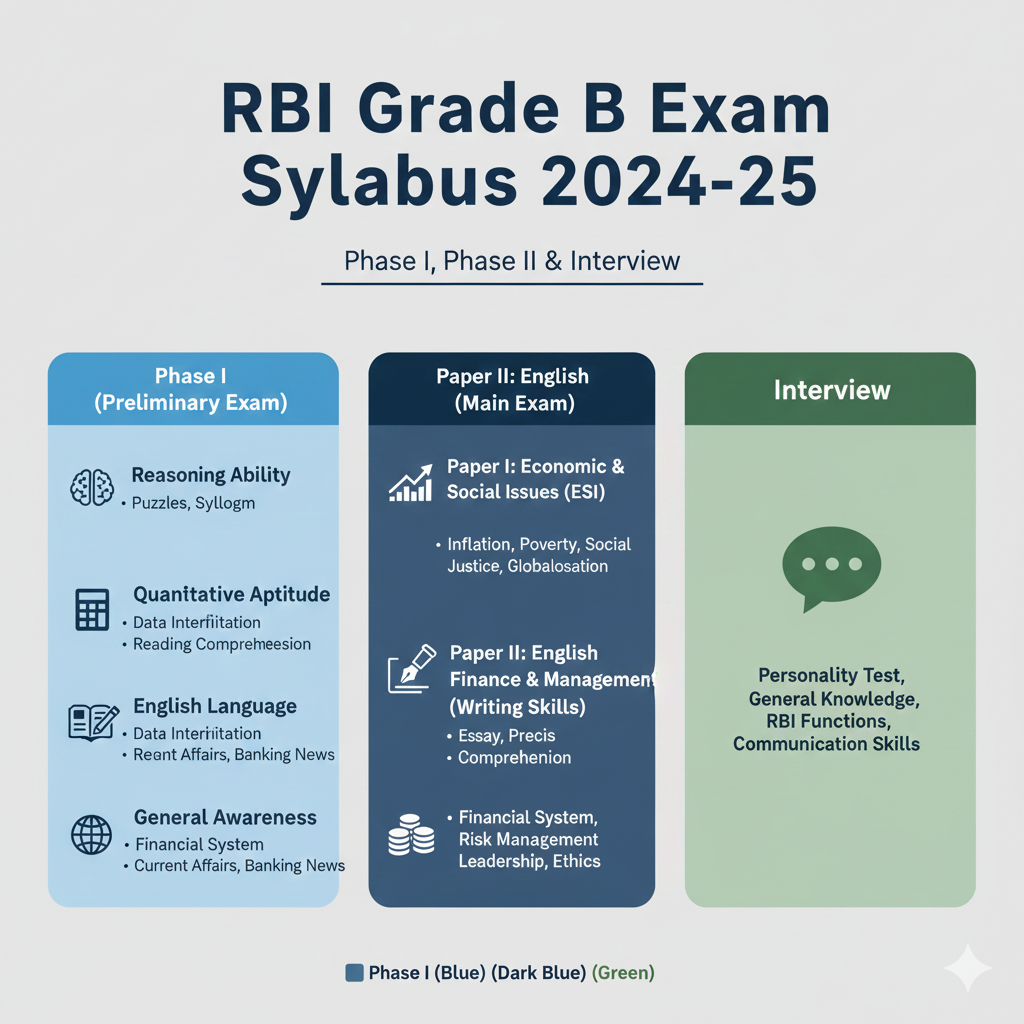
RBI Grade B Phase 1 Syllabus 2025
Section-wise Breakdown
Important Topics to Focus On
RBI Grade B Phase 2 Syllabus 2025
Paper 1: Economic and Social Issues (ESI)
Paper 2: Finance and Management (FM)
Paper 3: English Descriptive
RBI Grade B Interview Syllabus
Exam Pattern for RBI Grade B 2025
Preparation Tips to Crack RBI Grade B
Shortcuts / Tricks for Faster Preparation
Summary Notes
Practice MCQs (Original Only)
Introduction
The RBI Grade B exam is one of the most prestigious exams for aspirants who wish to work in India's central banking institution, the Reserve Bank of India (RBI). The exam is conducted in three phases: Phase 1, Phase 2, and Interview. In this blog, we will explore the RBI Grade B syllabus for 2025, covering the details of Phase 1, Phase 2, and the Interview round. This comprehensive guide will help you understand the topics to focus on, the pattern, and how to prepare for each stage of the exam.
RBI Grade B Phase 1 Syllabus 2025
Phase 1 of the RBI Grade B exam consists of Objective Type questions across four sections. The syllabus for Phase 1 is designed to test the candidate’s basic knowledge of General Awareness, Quantitative Aptitude, Reasoning, and English Language.
Section-wise Breakdown
General Awareness
Topics:
Current Affairs (National & International)
Banking Awareness
RBI and its Functions
Financial & Economic News
Government Schemes and Policies
Quantitative Aptitude
Topics:
Number Series
Data Interpretation (Pie charts, Bar graphs, etc.)
Simplification
Profit & Loss
Percentages
Time, Speed & Distance
Averages
Reasoning Ability
Topics:
Analytical Reasoning
Number Series
Blood Relations
Directions & Distance
Coding-Decoding
Syllogisms
Puzzles and Seating Arrangement
English Language
Topics:
Reading Comprehension
Sentence Correction
Cloze Test
Vocabulary (Synonyms & Antonyms)
Fill in the blanks
Important Topics to Focus On
For Phase 1, focus on high-weightage sections like General Awareness (current affairs and banking), Data Interpretation in Quantitative Aptitude, and Reasoning puzzles. It is essential to have a good command over English and stay updated with the latest news for the General Awareness section.
RBI Grade B Phase 2 Syllabus 2025
Phase 2 of the RBI Grade B exam is more advanced and includes three papers: Economic and Social Issues (ESI), Finance and Management (FM), and English Descriptive. Below is a detailed breakdown of each paper:
Paper 1: Economic and Social Issues (ESI)
Topics:
Economic Growth and Development
Monetary and Fiscal Policy
Inflation and Deflation
Banking Sector in India
Poverty, Unemployment, and Inequality
Sustainable Development and Social Welfare
Paper 2: Finance and Management (FM)
Topics:
Financial Management
Corporate Finance
Management Principles
Risk Management
Accounting and Financial Statements
Financial Markets and Instruments
Budgeting and Forecasting
Paper 3: English Descriptive
Topics:
Letter Writing
Essay Writing
Precis Writing
Comprehension-based Questions
RBI Grade B Interview Syllabus
The Interview round for RBI Grade B is the final phase, and it aims to assess a candidate’s personality, communication skills, knowledge of economics, banking, and their ability to contribute effectively to the RBI.
Key Areas:
Knowledge of RBI Functions and Monetary Policy
Awareness of current events and the Indian Economy
Personal Details: Education, work experience, motivation to join RBI
Situation-based Questions: To test decision-making and analytical abilities
Exam Pattern for RBI Grade B 2025
The RBI Grade B exam follows a multi-stage process that includes Phase 1, Phase 2, and the Interview. Here's a quick overview of the exam pattern:
Phase 1:
Duration: 2 hours
Sections: General Awareness, Quantitative Aptitude, Reasoning Ability, English Language
Total Marks: 200
Phase 2:
Duration: 3 hours (1 hour for each paper)
Papers: ESI, FM, and English Descriptive
Total Marks: 300
Interview:
Total Marks: 50
Preparation Tips to Crack RBI Grade B
Here are some valuable preparation tips for the RBI Grade B exam:
Strong Foundation in Economics: Focus on ESI and FM papers, as these are the most challenging. Develop a thorough understanding of macroeconomics, monetary policy, and financial markets.
Current Affairs: Stay updated on national and international news, banking reforms, and economic policies.
Practice Writing: For the English Descriptive paper, practice essay writing, precis writing, and letter writing.
Mock Tests: Take Phase 1 and Phase 2 mock tests regularly to improve speed and accuracy.
Revise Key Topics: Revise important topics for Reasoning, Quantitative Aptitude, and General Awareness.
Shortcuts / Tricks for Faster Preparation
Reasoning: Learn shortcut techniques for puzzles and series problems to save time during the exam.
Quantitative Aptitude: Master the use of shortcuts for percentage calculations, profit & loss, and simplification.
General Awareness: Use current affairs apps and weekly magazines to stay updated quickly.
Summary Notes
Phase 1: Focus on Quantitative Aptitude, Reasoning, and General Awareness.
Phase 2: Dive deeper into ESI, FM, and English Descriptive.
Interview: Be prepared with knowledge of the RBI’s functions, economic policies, and your personal background.
Practice MCQs (Original Only)
Which of the following is a major function of the RBI?
A) Commercial Banking
B) Fiscal Policy Formulation
C) Regulation of Money Supply
D) Financial Inclusion Programs
Answer: C) Regulation of Money Supply
Explanation: The RBI controls the money supply in the economy as part of its monetary policy.
What does the term "Repo Rate" refer to?
A) The rate at which banks lend to the public
B) The rate at which RBI lends to banks
C) The interest rate for savings accounts
D) The rate at which RBI borrows from commercial banks
Answer: B) The rate at which RBI lends to banks
Explanation: Repo rate is the rate at which RBI lends money to commercial banks.
Who is responsible for formulating the monetary policy in India?
A) Prime Minister
B) Finance Minister
C) Reserve Bank of India
D) Ministry of Home Affairs
Answer: C) Reserve Bank of India
Explanation: The RBI is responsible for formulating monetary policy in India.
Which of the following is a function of the RBI under the Banking Regulation Act, 1949?
A) Regulating money supply
B) Granting loans to the public
C) Issuing commercial bank licenses
D) Conducting economic surveys
Answer: C) Issuing commercial bank licenses
Explanation: The RBI has the authority to grant licenses to commercial banks under the Banking Regulation Act.
FAQs
Q1: What is the duration of the RBI Grade B Phase 1 exam?
A1: The Phase 1 exam lasts for 2 hours.
Q2: How many papers are there in Phase 2 of the RBI Grade B exam?
A2: Phase 2 consists of 3 papers: ESI, FM, and English Descriptive.